
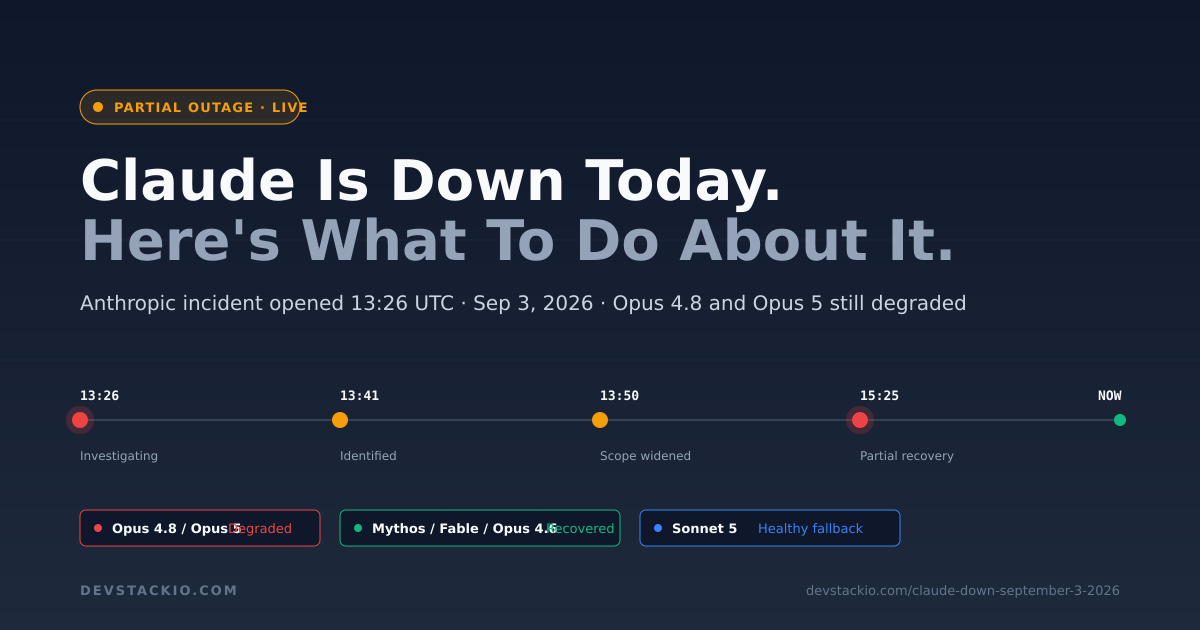
Anthropic’s Claude models experienced elevated errors on September 3, 2026, beginning at 13:26 UTC. The incident initially affected Claude Mythos 5.1, Claude Fable 5.1, and Claude Opus 5; by 15:25 UTC the scope had narrowed to Opus 4.8 and Opus 5, with Mythos, Fable, and Opus 4.6 recovered. This article is a post-incident retrospective: what happened, how to confirm an outage on your own end, and how to build fallback routing so a single-vendor incident costs you minutes instead of hours.
Timeline of the incident
| Time (UTC) | Status | What Changed |
|---|---|---|
| 13:26 | Investigating | Elevated errors reported on Mythos 5.1, Fable 5.1, Opus 5 |
| 13:41 | Identified | Cause identified; fix in progress |
| 13:50 | Update | Scope widened: Mythos/Fable 5.1, Mythos/Fable 5, Opus 5, Opus 4.8, Opus 4.6 |
| 14:49 | Update | Still working on a fix |
| 15:25 | Update | Mythos, Fable, and Opus 4.6 recovered. Opus 4.8 and Opus 5 still degraded. |
This pattern is consistent with Anthropic’s previous incidents: the largest, newest models degrade together, while smaller, older tiers (Sonnet, Haiku) tend to be more resilient because they run on wider, more mature serving infrastructure.
How to confirm the outage is upstream
Before failing over, confirm the problem is on Anthropic’s side and not yours:
- Check the status page. status.claude.com is the source of truth. Subscribe to the RSS/Atom feed for programmatic monitoring. A 20-line script can page your team the moment a component flips to Partial Outage.
- Corroborate. Downdetector for Anthropic, r/ClaudeAI on Reddit, and the @AnthropicAI account on X can confirm whether the impact is widespread or isolated to your account.
- Check your own error pattern. A sudden spike of 5xx errors, retries failing with the same error, and the same model slug affected across multiple customers in your logs means it’s upstream. Errors confined to a single model ID, region, or account suggest your own configuration.
During this incident, users reported 529 overloaded errors, higher latency on successful requests, streaming responses cutting off mid-reply, and tool-use failures where the model returned a function call but the harness could not reach the API to continue the loop.
Build model-tier fallback
The single most useful pattern is model-tier fallback: primary model, secondary on the same vendor, tertiary on a different vendor. The third hop is what saves you during a vendor-wide incident.
As of the incident, switching from Opus 5 to Sonnet 5 was the fastest option, Sonnet 5 had recovered from its own earlier incident and handles chat, summarization, and coding workloads well. If your prompt assumed Opus-class behavior, expect a quality drop on the hardest reasoning tasks.
A minimal Python fallback using the Anthropic SDK:
import anthropic

client = anthropic.Anthropic()

PRIMARY = "claude-opus-5-20260205"
FALLBACK = "claude-sonnet-5-20260601"

def call_with_fallback(messages, **kwargs):
    for model in (PRIMARY, FALLBACK):
        try:
            return client.messages.create(
                model=model,
                messages=messages,
                max_tokens=kwargs.get("max_tokens", 4096),
            ), model
        except anthropic.APIStatusError as e:
            if e.status_code in (529, 502, 503, 504) and model == PRIMARY:
                continue
            raise
    raise RuntimeError("all tiers failed")
Replace the fallback with whatever model slug is currently reporting Operational, check Anthropic’s models overview page for current slugs.
If you route through LiteLLM, OpenRouter, or Portkey, declare a primary model, a fallback list, and a retry policy per tier. OpenRouter example:
{
  "models": [
    {"slug": "anthropic/claude-opus-5", "fallbacks": ["anthropic/claude-sonnet-5", "z-ai/glm-5.3-flash"]}
  ],
  "policy": {
    "retries": 2,
    "backoff": "exponential",
    "circuit_breaker": {"error_rate": 0.3, "window": "60s"}
  }
}
The circuit breaker is the part most teams skip, and it is the part that matters during a real incident. Without it, your client retries into the same broken tier and adds load to a recovering system.
Claude Code and Claude Cowork
Claude Code and Cowork were listed as Partial Outage. The clients themselves work; what breaks is the round-trip to Opus 5. Two things help immediately:
- Pin a working model:
\/model claude-sonnet-5inside a session, or set the default in~\/.claude\/settings.jsonundermodel. - Don’t blast retry: long-running agent loops are the worst case during a partial outage, because each retry re-enters a degraded path. If you have queued work that can wait 30 minutes, let it wait.
Circuit breakers with real thresholds
If your error rate against Opus 5 exceeds 30% over a 60-second window, stop sending it traffic for 5 minutes. The default retry-everything behavior keeps you wedged into a degraded path longer than necessary.
Alert on status page changes
The Anthropic status page RSS/Atom feed is machine-readable. A 20-line script can page your team the moment a component flips to Partial Outage, before your SLOs even notice.
The operational lesson
This is not unique to Anthropic. OpenAI and Google have the same shape of incidents. The lesson is not that Claude is unreliable; it is that any single-vendor strategy is a single point of failure.
Build fallback routing now, while the outage is fresh in your mind, not when the next one starts.
References
- Anthropic status page, incident 461yvfrzpwtt (live timeline): status.claude.com
- Anthropic incident history (Aug 24, Sep 2 comparisons): status.claude.com
- Anthropic status RSS/Atom feed (programmatic monitoring): status.claude.com
- Anthropic models overview (current model slugs): docs.claude.com
Note: This is a retrospective of the September 3, 2026 incident. All timestamps are UTC. Status was current as of 15:25 UTC on September 3, 2026. Vendor-reported information only; no independent measurements cited as our own.
Related DevStackIO articles
- How to Use Claude Code for Free with OpenRouter—set up the OpenRouter fallback router described above
- Run an Open-Weight LLM on Ubuntu With Ollama—keep working locally when the Claude API is degraded
- How to Protect Git Repositories From AI Agent Abuse—scope tokens and require review for any fallback automation
Related Tools
Try these companion tools on DevStackIO Tools:
- system status page — check service availability and incident history.

Thank you for the comment